Why VSA Works for Large-Scale Memory
In classical Vector Symbolic Architectures (VSA) / Hyperdimensional Computing literature, the "capacity collapse" or catastrophic interference problem is frequently discussed. If we add all facts into a single global superposition vector M = F₁ + F₂ + ... + Fₙ, accumulating hundreds of facts causes the noise to overcome the signal, making information retrieval impossible.
In Astrum Verum, we use VSA differently. We do not store all knowledge in a single vector. Instead, we use VSA for role-binding within a single fact, while storing the facts themselves as independent records. However, this approach (searching across multiple hypervectors) introduces a unique mathematical problem — "Decoded Clarity Hallucinations".
Below we explain how we solved this problem and achieved mathematically guaranteed accuracy with a 5x search acceleration.
The Mathematics of Signal and Noise in VSA
We operate in a bipolar space of dimension D = 10,000, where each vector element belongs to {-1, 1}. The cosine similarity of two random vectors in such a space is normally distributed with an expected value of 0 and a standard deviation of σ = 1/√D = 0.01.
Each fact is formed as a majority-vote bundle of 3 components (Subject, Relation, Object):
When we unbind one component from the fact, the expected cosine similarity with the true vector is exactly 0.5 (or 50σ above the noise floor).
Distribution Graph
We ran a simulation for a dictionary of 10,000 concepts. Below is the cosine similarity distribution for correct extractions (Signal) and random noise (Noise).
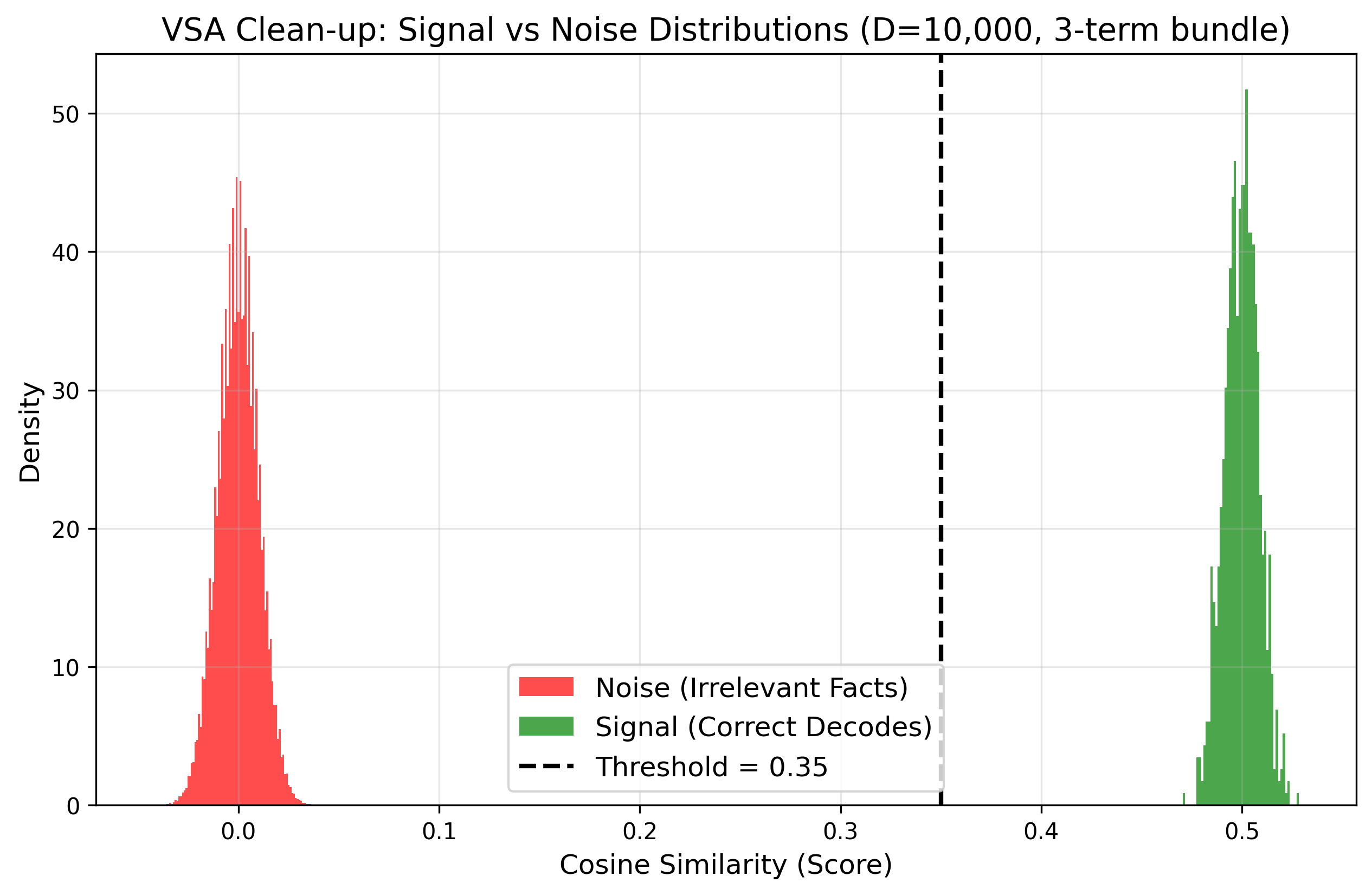
As shown in the graph, the signal and noise are separated by dozens of σ. True signals group around 0.5, while noise is strictly centered around 0.0 (with max outliers ~0.04).
The Problem: Hallucinations during Brute-force
Imagine the query: "Who does Alice love?". The probe is formed as:
We find the K nearest facts by cosine similarity (sorted by sims_facts) and for each one perform unbind and clean-up (comparison with 10,000 dictionary words).
What happens if we just take the fact with the "cleanest" decoding result (highest score)?
When iterating over many facts, variance occurs. An absolutely irrelevant fact might randomly produce a clean decode with score = 0.502, while the correct relevant fact yields score = 0.493. A simple maximum search will select the irrelevant fact, and the system will confidently output a false answer (hallucination).
The Solution: Match Quality & Early Exit
We solved this problem by combining the global relevance of the fact with the local clarity of the extracted concept.
1. Match Quality Metric
Instead of sorting solely by decode quality, we weight it by the relevance of the fact itself to our probe:
If an irrelevant fact randomly produces a high score (~0.5), its sims_facts will be close to 0, nullifying the result. This completely eliminates false positives.
2. Early Exit
Since we know the mathematics of our space, we don't need to iterate through all K facts. We introduced strict thresholds:
score > 0.35(guarantees filtering out 99.9999% of noise, which never exceeds 0.1)sims_facts > 0.20(guarantees the fact itself is relevant to the probe)
If the very first fact in the top results breaks these thresholds, we immediately stop searching, as we have a mathematical guarantee that we found the correct answer.
Performance Benchmarking
The unbind operation requires O(D) time, but clean-up (searching the entire dictionary) requires O(N × D) operations. Avoiding full Top-K scanning provides massive gains.
Profiling results (N=10,000, D=10,000, K=5 on pure Python/NumPy):
- Full scan (Top-K): ~27.30 ms
- Early Exit: ~5.55 ms
- Speedup: ~4.92x
At the scale of a real system with hundreds of thousands of concepts, this keeps response times within tens of milliseconds, making VSA an ideal solution for fast and accurate cognitive memory.